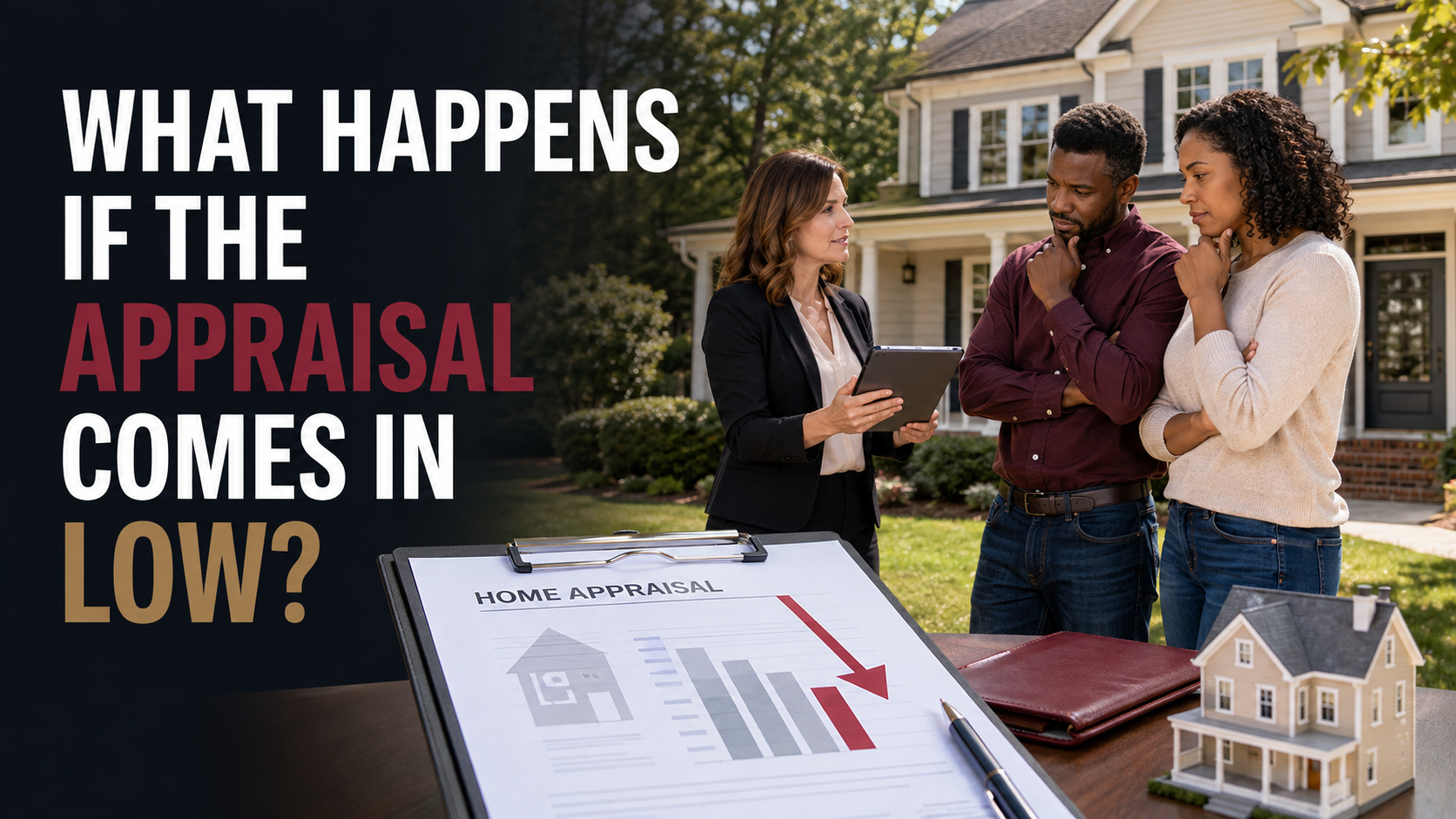
What happens if the appraisal comes in low in Georgia?
A low appraisal in Georgia means the lender will only finance against the appraised value, not the contract price — leaving a gap someone has to close. Buyers and sellers can renegotiate, split the difference, request a reconsideration of value, or terminate if an appraisal contingency protects the buyer.
A low appraisal is the one problem in a real estate transaction that money alone didn’t create and money alone can’t always fix. Nobody did anything wrong. The buyer offered what the home was worth to them, the seller accepted, and then a third party the lender hired said a number that was lower than both of them expected.
I’m Mark Robertson, a REALTOR® with the R&R Team at Berkshire Hathaway HomeServices Georgia Properties. I work with buyers and sellers across Newnan, Coweta County, Sharpsburg, Senoia, Peachtree City, and Grantville. Appraisal gaps have become a more frequent conversation here over the past year, and there’s a specific local reason for that — which I’ll get to.
Here’s what actually happens when the appraisal comes in low in Georgia, and what your options really are on both sides of the table.
Why Does a Low Appraisal in Georgia Matter?
Your lender is not lending against what you agreed to pay. The lender lends against the appraised value. That’s the whole mechanism.
If you’re under contract at $400,000 with 20% down, your lender expected to finance $320,000. If the appraisal comes back at $380,000, the lender will now generally finance 80% of $380,000 — $304,000. That $16,000 difference doesn’t disappear. It becomes cash somebody has to bring, or a price somebody has to move.
An appraisal gap is simply the difference between the appraised value and the contract price. Nationally, roughly 8.6% of appraisals came in below contract price in early 2026, according to figures published by AmeriSave. It’s not the common outcome — but it’s common enough that both buyers and sellers should know the playbook before it happens.
Why this is coming up more often around Newnan right now
Appraisers value a home using recent closed comparable sales. In a market where prices are drifting downward, those closed comps reflect a slightly earlier, slightly higher-priced moment — or, if the decline is steeper, they come in under what a buyer was willing to pay based on what they saw listed.
The Coweta County data is genuinely mixed, and I’d rather show you the spread than pick the number that makes the best story:
| Source & measure | Newnan | Coweta County |
|---|---|---|
| Redfin, median sale price, single month year-over-year | Down 10.8% (Feb 2026, ~$328K) | Down 14.1% (Jan 2026, ~$365K) |
| Zillow, smoothed home value index, year-over-year | Down 1.8% (~$368,567) | Down 1.5% (~$393,800) |
Those are very different pictures, and the honest read is that both are true measurements of different things. Single-month median sale prices swing hard based on which homes happened to close that month — a few large sales or a few small ones move the median a lot. Smoothed value indexes are more stable but slower to reflect turns. (Sources: Redfin, Zillow.)
What I’d take from it: the direction is softer, not stronger, and softening markets are where appraisal gaps show up. Newnan homes also took an average of 76 days to sell versus 93 days a year earlier per Redfin. Treat all of these as snapshots that move monthly, not as fixed facts.
What Are the Buyer’s Options After a Low Appraisal?
You generally have five, and they aren’t mutually exclusive:
- Ask the seller to reduce the price to the appraised value. The cleanest fix, and more achievable in a softer market than most buyers assume — especially if the seller knows the next buyer’s lender will likely order an appraisal that lands in the same place.
- Cover the gap in cash. You bring the difference to closing on top of your down payment. This is real out-of-pocket money, and it means paying above what a licensed appraiser said the home is worth.
- Split the difference. Extremely common. You move up, the seller moves down, and the deal survives.
- Request a Reconsideration of Value (ROV). More on this below.
- Terminate, if a contingency protects you. Whether your earnest money is safe depends entirely on what your contract says and where you are in the timeline.
That last point deserves emphasis. An appraisal contingency is not automatic — it’s a contract term. If you waived it to win a competitive offer, walking away over a low appraisal may put your earnest money at risk. Read your contract, and ask your closing attorney if there’s any ambiguity.
What is a Reconsideration of Value, and does it work?
An ROV is a formal request to the lender asking the appraiser to revisit the valuation. It sometimes works. It works far more often when it’s built correctly.
An ROV must present facts, not opinions. Specific closed sales the appraiser didn’t use. Corrections to factual errors — wrong square footage, wrong bedroom count, a finished basement recorded as unfinished, a recent renovation not reflected. What does not work is arguing that you think the home is worth more, or that you really want the house.
This is a place where your agent earns their keep. Pulling genuinely comparable closed sales that an appraiser overlooked, and documenting property-condition facts accurately, is exactly the work I’d be doing on your behalf here. I’d also set expectations honestly: many ROVs don’t change the number.
What Are the Seller’s Options After a Low Appraisal?
If you’re selling, a low appraisal is not the same as a failed deal — but it is a decision point, and the clock is running.
- Reduce to the appraised value. Frustrating, but consider the alternative: if this buyer walks, the next buyer’s lender orders a new appraisal, likely using the same comparable sales. The problem tends to follow the property, not the buyer.
- Hold firm and see if the buyer covers the gap. A legitimate position, particularly if the buyer has cash flexibility. It’s also the option most likely to end the contract.
- Meet in the middle. Usually where these land.
- Support a Reconsideration of Value. You and your agent may have comparable sales and property information the appraiser didn’t have — recent upgrades, permitted additions, or comps in a subdivision the appraiser isn’t familiar with. Provide facts.
- Offer a concession instead of a price cut. Sometimes a closing cost credit bridges the practical gap even when the price stays put. Whether that works depends on the buyer’s loan program and lender guidelines.
One thing worth doing well before this moment: price against real comparable sales from the start. The most reliable way to avoid an appraisal gap is to set a list price the closed comps can actually support. That conversation belongs at the listing appointment, not on day twenty-two of a contract.
Does a Cash Buyer Change Any of This?
Largely, yes. A buyer paying cash with no financing generally isn’t required to get an appraisal, because there’s no lender requiring one. Some cash buyers order one anyway as a check on their own decision, and some cash contracts still include an appraisal contingency by agreement.
This is part of why cash offers carry weight beyond speed — they remove appraisal risk from the transaction entirely.
Frequently Asked Questions
Can I still get my earnest money back if the appraisal comes in low in Georgia?
It depends on your contract. If you have an appraisal contingency in place and you’re within its timeline, you generally can terminate and recover your earnest money. If you waived that contingency — which some buyers do to strengthen a competitive offer — your earnest money may be at risk. Confirm your specific terms with your closing attorney before you act.
Who pays for the appraisal, and do I get to see it?
The buyer typically pays for the appraisal as part of financing costs, usually bundled into lender fees. Because you paid for it, you’re generally entitled to a copy from your lender. Ask for it — you’ll need the actual report to evaluate whether an ROV is worth pursuing.
Are low appraisals common in Newnan and Coweta County right now?
They’re a live concern rather than an epidemic. Published national figures put below-contract appraisals around 8.6% in early 2026, and local price data has been trending softer, which is generally the condition where gaps appear. But appraisal outcomes are property-specific — a well-priced home with strong recent comps in its own subdivision often appraises without drama.
Can I use my own appraiser instead?
Not for your lender’s purposes. The lender orders the appraisal through an independent process specifically so the valuation isn’t influenced by the parties to the transaction. You can pay for a second private appraisal for your own information, but your lender will underwrite to theirs.
If You’re Staring at a Low Appraisal Right Now
This is a solvable problem far more often than it feels like in the moment — but the options narrow as the contract timeline moves. If you’re mid-transaction in Newnan, Sharpsburg, Senoia, Peachtree City, Grantville, or anywhere in Coweta County and the number came in under contract price, let’s talk through what your contract actually allows before you make a decision.
Call or text me at 678-763-0715.
About the Author
Mark Robertson is a REALTOR® with the R&R Team at Berkshire Hathaway HomeServices Georgia Properties, serving buyers and sellers across Newnan, Coweta County, Sharpsburg, Senoia, Peachtree City, and the broader South Metro Atlanta area. Call or text 678-763-0715.
Published August 5, 2026. Market data and lending practices change — confirm current figures before relying on them. General information, not legal or financial advice; consult your closing attorney and lender regarding your specific transaction. Each Berkshire Hathaway HomeServices franchise is independently owned and operated. Equal Housing Opportunity.
Leave a Reply