How are property taxes calculated in Coweta County, Georgia?
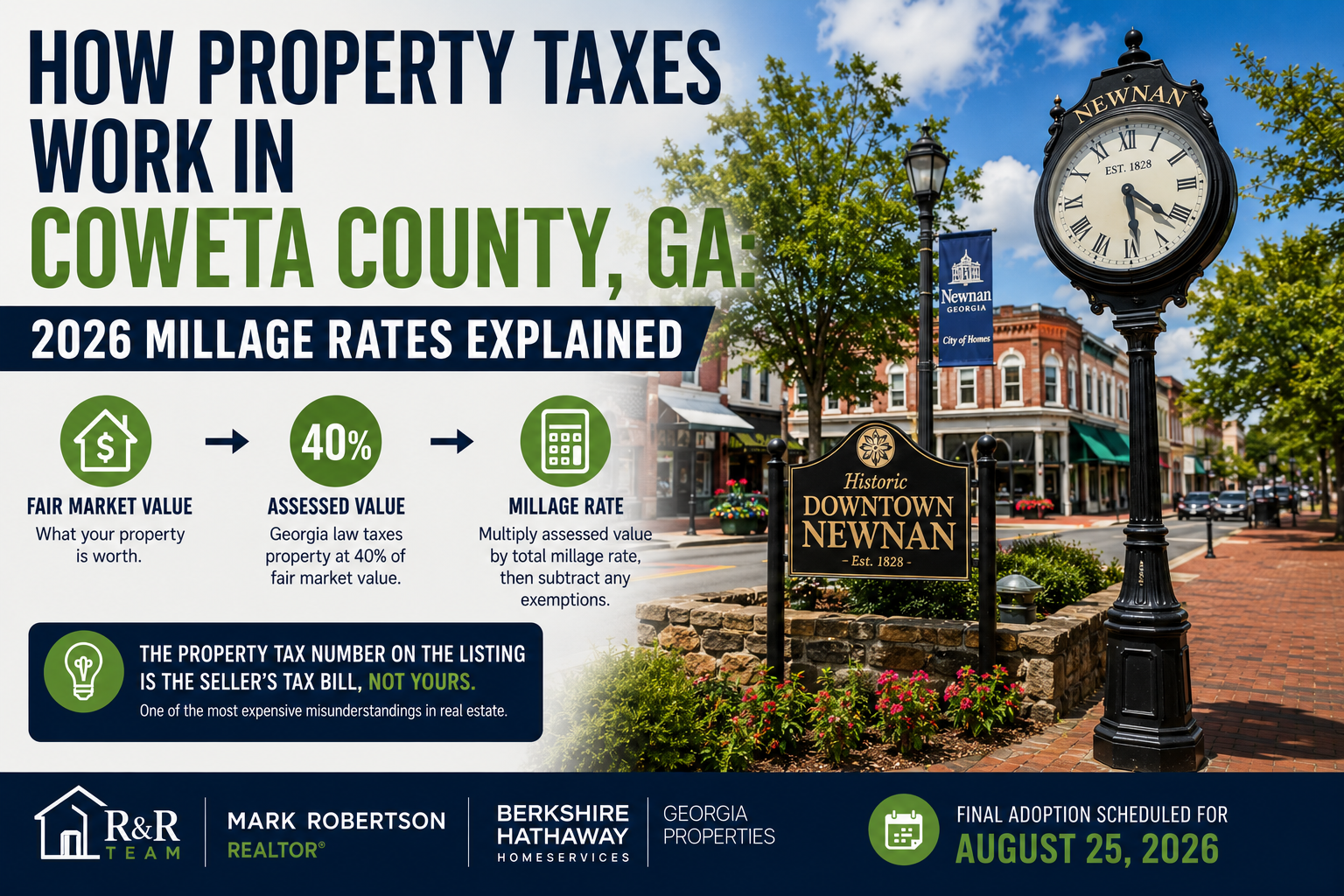
Georgia taxes property at 40% of fair market value. Multiply that assessed value by the combined millage rate, then subtract any homestead exemptions. In Coweta County the proposed 2026 county rate is 7.872 mills, plus 15.00 mills for schools.
Here is the sentence I say most often to buyers moving into Coweta County: the property tax number on the listing is the seller’s tax bill, not yours. It is one of the most expensive misunderstandings in real estate, and it shows up about six months after closing when the escrow analysis lands.
I’m Mark Robertson, a REALTOR® with the R&R Team at Berkshire Hathaway HomeServices Georgia Properties. This week is a good time to explain how Coweta County property taxes actually work, because the Board of Commissioners is in the middle of setting the 2026 millage rate right now — with final adoption scheduled for August 25, 2026.
How Is a Property Tax Bill Calculated in Georgia?
Three numbers, in order.
1. Fair market value. The Coweta County Board of Assessors determines what your property is worth. Each year between January 1 and April 1, property owners may declare a proposed value by filing a return.
2. Assessed value — 40% of fair market value. This is statewide Georgia law, and it trips up buyers relocating from states that tax on full value. A $400,000 home has a $160,000 assessed value.
3. The millage rate. One mill equals $1 of tax per $1,000 of assessed value. Your total rate stacks several separate levies: the county, the school system, your city if you’re inside one, and any special service districts.
The formula: (assessed value − exemptions) ÷ 1,000 × total millage rate.
The Coweta County Tax Commissioner’s office publishes the mechanics in plain language, and it’s worth ten minutes of any homeowner’s time.
What Are Coweta County’s 2026 Millage Rates?
The Board of Commissioners announced its proposed rates in early August. Here is the county portion, compared to 2025:
| Levy | 2025 | 2026 (proposed) | Change |
|---|---|---|---|
| General Maintenance & Operations | 4.817 | 4.011 | −0.806 |
| Countywide 911 | 0.321 | 0.353 | +0.032 |
| Countywide EMS | 0.402 | 0.411 | +0.009 |
| Countywide Parks & Recreation | 0.397 | 0.414 | +0.017 |
| Fire District* | 2.500 | 2.500 | 0.000 |
| Fire Bond* | 0.189 | 0.183 | −0.006 |
| County total | 8.626 | 7.872 | −0.754 |
Separately, the Coweta County Board of Education has maintained its local school rate at 15.00 mills.
Key takeaway: The county’s total proposed rate is down roughly 8.7% year over year, yet the county is legally required to advertise this as a tax increase. Both things are true, and the reason is worth understanding.
Why Is a Lower Rate Still Called a “Tax Increase”?
Because Georgia measures increases against the rollback rate, not against last year’s rate.
When reassessments push property values up, state law requires the county to compute a rollback millage rate — the rate that would produce the same total revenue as last year, as if no reassessment had happened. For 2026 that figure started at 4.755 mills. Five months of Floating Local Option Sales Tax (FLOST) collections totaling $10.9 million knocked another 0.999 mills off, bringing the rollback rate to 3.756 mills.
The proposed General M&O rate of 4.011 mills sits 6.8% above that rollback rate. Hence the required advertisement and three public hearings — even though 4.011 is a 16.7% cut from last year’s 4.817.
Two practical implications for homeowners:
- A falling millage rate does not guarantee a falling tax bill. If your assessment rose more than the rate fell, you can pay more.
- FLOST is only partially in effect for 2026. The county has indicated a full twelve months of collections will offset property taxes for tax year 2027.
What Would a Coweta County Tax Bill Actually Look Like?
Here’s a worked illustration on a $400,000 home, using the proposed 2026 county rates plus the 15.00-mill school rate, before any homestead exemption:
| Unincorporated Coweta | Inside Newnan city limits | |
|---|---|---|
| Fair market value | $400,000 | $400,000 |
| Assessed value (40%) | $160,000 | $160,000 |
| County millage | 7.872 | 5.189 (no fire levies) |
| School millage | 15.00 | 15.00 |
| City millage | — | 0.000 |
| Total millage | 22.872 | 20.189 |
| Estimated annual tax | $3,659 | $3,230 |
That’s roughly a $429 annual difference on an identical home, driven almost entirely by the fire district levies that city addresses don’t pay.
And note the zero in the city row. Newnan homeowners currently pay no city property tax — after voters approved a one-cent sales tax in November, the City Council used that revenue to offset the municipal property tax rate to zero.
These are illustrations, not quotes. Rates are proposed until adopted, exemptions vary by household, and your parcel’s assessed value is specific to your property. Verify with the Assessor’s Office at (770) 254-2680.
What Homestead Exemptions Are Available, and When Must You File?
This is the part that costs Coweta homeowners real money through simple inaction.
A homestead exemption reduces the assessed value your tax rate is applied to. Georgia provides several State Exemptions, and Coweta County adds Local County Exemptions on top — where the local amount is greater, it supersedes the state amount. Additional exemptions exist tied to age, income, disability, and military service.
The rules that matter most:
- You must own AND occupy the home as your legal residence as of January 1 of the year you first claim it.
- The application must be received by April 1. Applications after that date apply to the next tax year. Georgia allows year-round filing, so there’s no reason to wait.
- You apply with the Board of Assessors, not the Tax Commissioner — 37 Perry Street, Newnan, (770) 254-2680.
- You cannot hold a homestead exemption on any other property, in another Georgia county or another state. Doing so is unlawful.
- Once granted, it renews automatically — unless you change residence, change ownership, or want to qualify for a different exemption type.
That fifth point is where I see buyers get burned. Your seller’s homestead exemption does not transfer to you. If you closed in 2026, you file your own application by April 1, 2027. Nobody from the county will call to remind you. The Tax Commissioner’s homestead exemption page lays out the requirements, and the Coweta County Assessor’s Office can walk you through which exemptions you qualify for.
Could Newnan’s City Tax Situation Change?
It might, and buyers looking inside the city limits should know the conversation is live.
Newnan Mayor James Shepherd has proposed making the current zero city tax on owner-occupied homes permanent, rather than leaving it dependent on each year’s council vote. The concept, as reported by The Citizen, would create a large homestead exemption — in the range of $750,000 to $1 million — through state legislation and a local referendum, while restoring a roughly two-mill rate on non-homesteaded property such as businesses and rental homes.
The path is long: a council request to the General Assembly, passage during the 2027 legislative session, then a voter referendum, with a possible effective date of January 2028.
What this means practically: if you’re buying a home in Newnan, the zero city rate is real today but rests on an annual council decision. If you’re buying a rental or investment property inside the city, watch this closely — the proposal would shift city property tax onto non-homesteaded property.
What Should Buyers and Sellers Do About Taxes at Closing?
A few things I handle on every transaction:
- Never budget from the listing’s tax figure. It may reflect the seller’s exemptions, an older assessment, or both. Estimate from the current assessed value and current millage instead.
- Confirm whether the address is inside a city limit. As the table above shows, it’s worth hundreds of dollars a year, and Newnan addresses don’t always mean Newnan city limits.
- Taxes are prorated at closing, but the county records the lien in the January 1 owner’s name. If you sold and taxes were prorated, bring your closing statement to the Tax Commissioner’s Office within 90 days of the due date so the record follows the right owner.
- Calendar two dates: Coweta tax bills are normally due December 1, and homestead applications are due April 1.
- You have 45 days to appeal an assessment from the date of your assessment notice, to the Board of Equalization or an arbitrator. That window is strict.
Frequently Asked Questions
Do I have to reapply for homestead exemption when I buy a house in Coweta County?
Yes. The prior owner’s exemption doesn’t transfer. You must own and occupy the home as of January 1, and your application must reach the Board of Assessors by April 1 of the year you first claim it. After that, it renews automatically unless your residence, ownership, or exemption type changes.
Why did my Coweta County tax bill go up when the millage rate went down?
Almost always reassessment. Your bill is assessed value times millage. If the Board of Assessors raised your fair market value by more than the rate fell, the bill rises even with a lower rate. That’s exactly the dynamic the rollback rate calculation is designed to surface.
Are property taxes lower inside Newnan city limits than in unincorporated Coweta County?
Currently, yes — on two counts. Newnan addresses inside the city are not subject to the county Fire District and Fire Bond levies, and the city’s own property tax rate is presently zero. On a $400,000 home that’s roughly a $429 annual difference before exemptions. Verify any specific parcel with the Assessor’s Office.
When is the Coweta County millage rate final for 2026?
Adoption is scheduled for August 25, 2026 at 6:00 p.m. in the Commission Chambers at 37 Perry Street in Newnan, following public hearings held August 11 and the morning of August 25. Until then the rates are proposed.
What happens if I pay my Coweta County property taxes late?
After 30 days unpaid, a lien (FiFa) may be recorded with the Clerk of Superior Court, which is a public record credit bureaus can access. Interest accrues at bank prime plus 3% per month, and a 5% penalty applies and can repeat every 120 days up to a 20% cap.
Want a Real Tax Estimate Before You Write an Offer?
Guessing at this number is how buyers end up with an escrow shortage they didn’t plan for.
Schedule a free consultation. I’ll pull the actual assessed value on any Coweta County property you’re considering, apply the current millage for that specific address, and show you what the bill realistically looks like — before you’re under contract. Call or text 678-763-0715, or email marcus46521@gmail.com.
About the author: Mark Robertson is a REALTOR® with the R&R Team at Berkshire Hathaway HomeServices Georgia Properties, serving buyers and sellers across Newnan, Coweta County, Sharpsburg, Senoia, Peachtree City, and the broader South Metro Atlanta area. Call or text 678-763-0715.
Published August 12, 2026. Millage rates described here were proposed and not yet adopted as of publication; verify current figures with Coweta County before relying on them. This article is general information and is not tax or legal advice — consult the Coweta County Board of Assessors at (770) 254-2680, the Tax Commissioner’s Office at (770) 254-2670, or a qualified tax professional about your specific property. Mark Robertson, REALTOR®, R&R Team | Berkshire Hathaway HomeServices Georgia Properties. Equal Housing Opportunity.
Leave a Reply