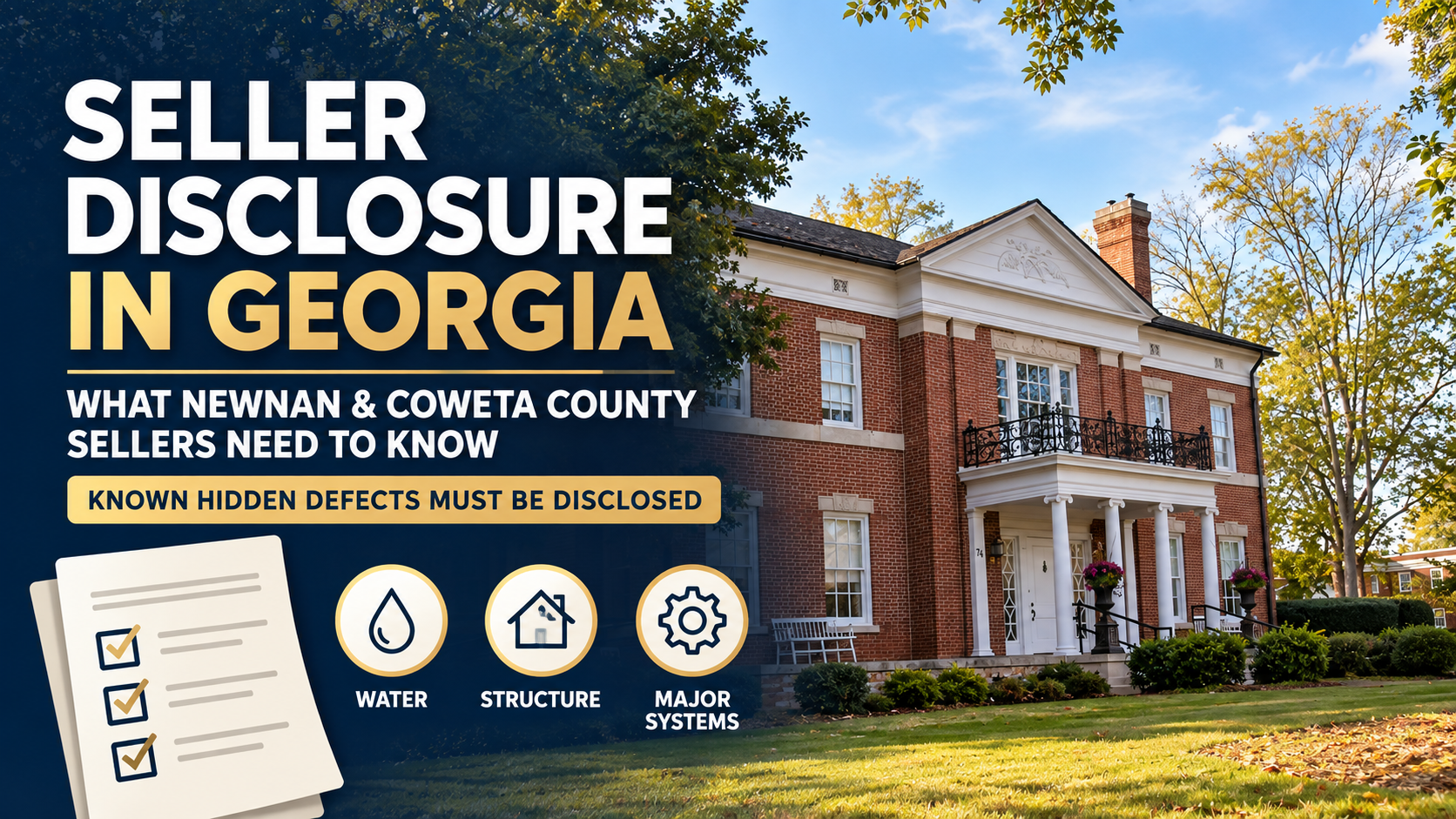
What do sellers have to disclose in Georgia? Georgia is a “buyer beware” state, but sellers must disclose known hidden defects a buyer couldn’t reasonably find, even in an as-is sale. Seller disclosure in Georgia is usually documented on the GAR F301 form.
Table of Contents
- What Does Seller Disclosure in Georgia Actually Require?
- Is the GAR F301 Seller’s Property Disclosure Statement Required?
- Does Selling “As-Is” Protect Me From Disclosure?
- What Do Newnan and Coweta County Sellers Most Often Need to Disclose?
- What Don’t You Have to Disclose?
- How Do I Complete the F301 Step by Step?
- Why Does Clear Disclosure Matter in the Current Coweta County Market?
- Frequently Asked Questions
Picture this: the offer is in, the inspection is done, and then the buyer’s agent asks why the crawl space smells musty when your disclosure says “no known water issues.” That moment is why seller disclosure in Georgia deserves a careful read before you list, not after you’re under contract.
I’m Mark Robertson, a REALTOR® with the R&R Team at Berkshire Hathaway HomeServices Georgia Properties, and I help Newnan and Coweta County sellers work through disclosures every week. This guide covers what the law expects, what the F301 form asks, and how to fill it out honestly without over-worrying. It is general education, not legal advice, so your real estate attorney should weigh in on anything specific to your home.
What Does Seller Disclosure in Georgia Actually Require?
Georgia follows caveat emptor, or “buyer beware,” which means sellers generally don’t have to volunteer every flaw a house has. But there is a firm exception: a seller who knows about a material defect that a buyer can’t discover through reasonable inspection has to disclose it.
Georgia REALTORS® describes a latent defect as a flaw that exists but can’t be readily observed without specialized knowledge, and says sellers must disclose such defects even when the home is sold as-is (see the Georgia REALTORS® disclosure guidance). Nolo’s Georgia summary adds that failing to disclose known defects can expose a seller to fraud, misrepresentation, or breach of contract claims.
In plain terms: if you know about it, it matters, and the buyer couldn’t easily spot it, put it in writing.
Is the GAR F301 Seller’s Property Disclosure Statement Required?
The F301 is the Georgia Association of REALTORS® form most agents use to document what a seller knows about the property. Georgia law itself does not appear to require a specific state form, according to Nolo, but the F301 is widely used because it helps sellers meet their duty to disclose hidden defects. Ask your listing agent and attorney how it will be handled in your transaction.
The form asks about the roof, foundation, plumbing, electrical, HVAC, water intrusion, drainage, pests, additions, and more. Answer from your actual knowledge, and use “unknown” or “no knowledge” only when that is genuinely true.
Does Selling “As-Is” Protect Me From Disclosure?
No. As-is describes the price and repair expectations, not permission to stay quiet about known hidden problems. An as-is buyer still gets to inspect during the due diligence period, and you still owe honest answers on what you know. If you want a refresher on that window, read our guide to the due diligence period in Georgia.
What Do Newnan and Coweta County Sellers Most Often Need to Disclose?
Every home is different, but these are the categories I walk sellers through before listing:
- Water and drainage: past or present leaks, crawl space moisture, roof leaks, or grading issues that pool water near the foundation.
- Structure: foundation cracks or movement you know about, and any repairs made.
- Septic and well: many Coweta County homes, especially those with acreage in areas like Sharpsburg or Senoia, rely on septic systems or wells, so pump-out history and known problems belong on the form.
- Wood-destroying organisms: termite or pest treatment history, damage, and any active bond.
- Systems and roof: known HVAC, plumbing, or electrical defects, and approximate roof age if you know it.
- Additions and permits: work done without permits or with an owner-do-it-yourself approach that a future buyer would want to know about.
- Neighborhood matters: HOA dues, special assessments, and known covenant issues that affect the property.
What Don’t You Have to Disclose?
Georgia law treats certain facts as “stigmatized.” According to Nolo, sellers generally can’t be sued for not disclosing that a death or felony occurred at the property or for diseases highly unlikely to spread through occupancy. However, if a buyer asks you a direct question, answer it truthfully. Talk to your agent before responding to anything that feels uncertain.
Also remember that if your home was built before 1978, federal law requires disclosure of known lead-based paint hazards and delivery of the EPA pamphlet. The EPA’s lead real estate disclosure page explains the requirement.
How Do I Complete the F301 Step by Step?
- Gather your records. Pull repair receipts, warranties, termite bonds, septic pump-out records, and permits.
- Walk the property with fresh eyes. Look at the attic, crawl space, garage walls, and around the foundation after a rain.
- Answer honestly and specifically. If something was repaired, say what, when, and who did it, and attach documentation if you have it.
- Have your agent review it. A second set of eyes catches gaps and vague wording.
- Update it if something changes. If a new issue appears before closing, tell your agent and attorney right away.
- Keep a copy. Your closing attorney handles the final paperwork in Georgia, so keep your own file for reference.
If you’re also weighing timing, my post on whether to sell before buying in Newnan covers the sequencing decisions that often go hand in hand with disclosure prep.
Why Does Clear Disclosure Matter in the Current Coweta County Market?
When buyers have more room to negotiate, surprises after inspection tend to cost sellers more. Redfin’s August 2026 snapshot for Coweta County shows a market where buyers are taking their time (figures vary by source and month, so treat them as a guide):
| Coweta County (Aug 2026) | Redfin figure |
|---|---|
| Median sale price | $403,649 |
| Homes sold in August | 206 |
| Average time on market | 52 days |
| Sale-to-list price ratio | 97.5% |
| Listings with price reductions | 26% |
Source: Redfin, Coweta County housing market. Because roughly one in four listings had a price reduction, clear seller disclosure in Georgia, backed by documents, helps your home stand out as a low-drama purchase. It also pairs well with a pre-listing walkthrough, and if repairs do come up later, our guide on negotiating repairs after a home inspection in Georgia shows how those conversations typically work.
Frequently Asked Questions
Do I have to fill out a seller’s disclosure form in Georgia?
Seller disclosure in Georgia does not appear to hinge on one mandated state form, but most sellers complete the GAR F301 because it documents what you know and supports your duty to disclose hidden defects. Ask your agent and attorney how it applies to your sale.
Can a buyer sue me after closing for something I didn’t know about?
Generally, claims center on what a seller knew and failed to disclose. Answering from your actual knowledge and keeping records of repairs helps, but for a specific situation, talk with a Georgia real estate attorney.
Do I need to disclose that my Newnan home has a septic system?
Yes, it’s smart to disclose the septic system and any known problems or service history. Many homes in Coweta County communities such as Sharpsburg and Senoia are on septic or wells, so buyers expect to see it addressed.
What if I find a new problem after I’ve already signed the F301?
Tell your listing agent and closing attorney promptly so the disclosure can be updated. Waiting rarely helps, and honest updates usually keep the deal on track.
About the Author
Mark Robertson is a REALTOR® with the R&R Team at Berkshire Hathaway HomeServices Georgia Properties, serving buyers and sellers across Newnan, Coweta County, Sharpsburg, Senoia, Peachtree City, and the broader South Metro Atlanta area. Call or text 678-763-0715.
Worried about what to put on your disclosure? DM me or call 678-763-0715, and we’ll go through your home room by room before you list. — Mark Robertson, REALTOR®, R&R Team | Berkshire Hathaway HomeServices Georgia Properties.
Published September 30, 2026. Market figures reflect Redfin’s August 2026 data and may change. This article is general information, not legal advice; consult a Georgia real estate attorney about your situation.
Leave a Reply